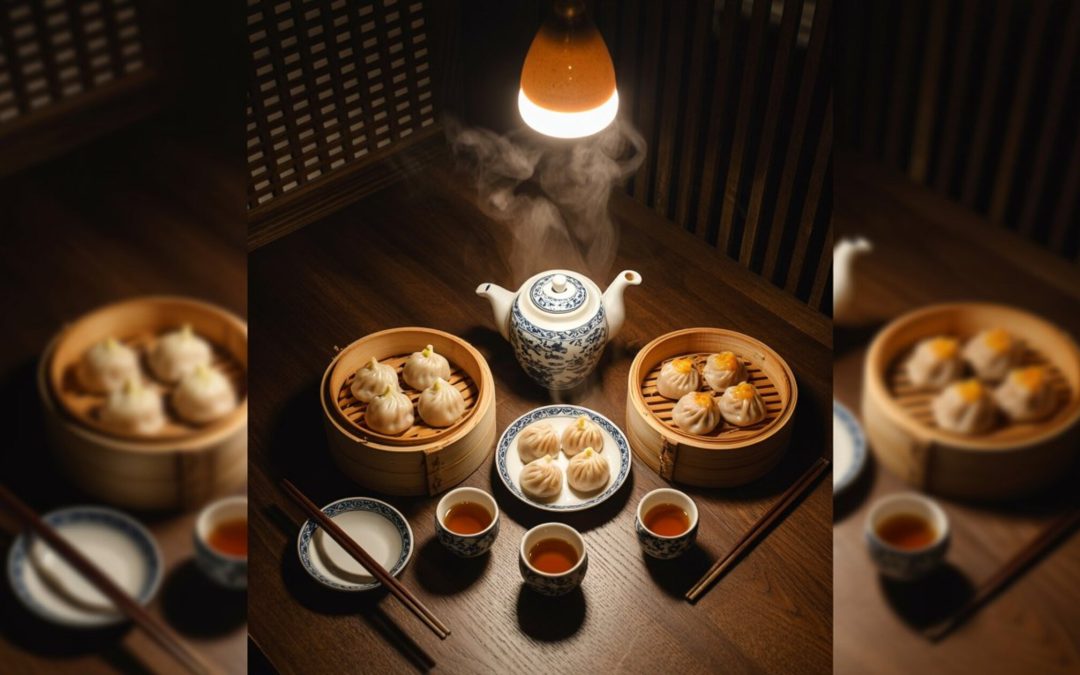
Dim sum catches first-timers off guard. You walk in expecting to order an entree and a side dish. Instead, someone pours tea, and small plates just start arriving. Steamed dumplings in bamboo baskets. Fried things. Baked buns. Each one is two, maybe three bites. You eat one, reach for the next, talk for a while, order another round. An hour goes by. You have been eating the entire time and somehow you are not stuffed.
Once you get used to that pace, ordering one main course and sitting there waiting for it feels weirdly limited.
Where it all started
The whole thing began in teahouses along China’s Silk Road. Traders passing through Guangdong Province on the southern coast would stop for tea. Small snacks came with it, almost as an afterthought. Nobody planned for those snacks to become anything special.
But they did. Over centuries, the food got more and more ambitious. Steamed dumplings with translucent wrappers. Baked buns stuffed with roasted pork. Rice noodle sheets rolled so thin you could practically see through them. The Cantonese still call the occasion “yum cha,” which means drink tea. Because the tea was the original excuse for sitting down. The food just got a lot more interesting than anyone expected.
If you want to understand why Cantonese cooking is so restrained and why ingredients do most of the talking, Cantonese Cuisine Explained goes deeper on that philosophy. It is the same thinking that sits underneath every dim sum dish.
How dim sum landed in Jeddah
Jeddah has been a port city for centuries. Chinese culinary influences arrived early through merchant communities and trade routes. But dim sum specifically took a while to get established here. The setup is demanding. You need proper bamboo steamers stacked in tiers, a team trained in wrapper-making and hand-folding, and the kitchen rhythm to push out dozens of different items without anything sitting around too long.
Most Chinese restaurants skip that investment. The ones that commit to it produce food that is noticeably different from reheated frozen dumplings. Diners pick up on that immediately.
Toki has been serving dim sum since its earliest years in Jeddah. Over time it became one of the things the restaurant is best known for. The story behind Toki’s MICHELIN Guide recognition traces how more than 25 years of consistency built that reputation. Dim sum was part of it from the start.
What actually goes on a dim sum table
Most people assume dim sum means dumplings. It does, partly. But a full dim sum table has a lot more going on. Steamed parcels, fried items, baked pastries, rice noodle rolls, turnip cakes, taro puffs. Some of these have no real equivalent in Western food. The range is what keeps you interested across an entire meal.
Steamed dishes
This is the core. Steaming is the most exposed cooking method in the kitchen. There is no oil to add crunch, no oven to create colour. Just the wrapper, the filling, and the timing. If any of those are off, you taste it right away.
The Crystal Shrimp Har Gao at Toki is the dish to pay attention to. The wrapper is wheat starch, not regular flour, and it turns translucent under steam. Each one is hand-pleated into a crescent. Inside, whole shrimp stay firm and sweet. Not minced, not blended. Chefs judge dim sum kitchens by their Har Gao. If that dish is right, the rest of the menu probably is too.
The Xiao Long Bao works differently. These are Guangzhou-style chicken dumplings with broth sealed inside. The broth starts as a gelatinised stock, solid at room temperature. During steaming it melts into liquid. So you bite in and get filling and hot soup at the same time. The wrapper has to be thin enough to not taste doughy but strong enough to hold liquid without tearing. Getting that balance right is as much an engineering problem as a cooking one.
For the full breakdown of how steamed, fried, and baked dim sum differ, Types of Dim Sum You’ll Find at Toki covers each category.
Fried and baked dishes
After a few steamed courses, a fried item changes the whole pace. Pan-fried dumplings with a golden crust on the bottom. Spring rolls with shells so thin they shatter on first bite. These show up between steamed rounds, not alongside them. The contrast is the point.
On the baked side, Char Siu Bao has a lightly sweet crust that caramelises in the oven. The barbecued meat filling inside is sticky and faintly smoky. It is a completely different dish from the steamed version of the same bun, even though they share a name.
Rice noodle rolls
Cheung fun gets skipped by first-timers and ordered every single week by regulars. A thin sheet of rice flour batter, steamed until it barely sets, rolled around shrimp or char siu and dressed with a light soy. The texture is slippery, silken. Nothing else on the table feels like it. Most people discover this dish last and immediately wish they had found it earlier.
How to order without overordering
Start with three or four steamers for the table. Eat them. Talk. Then order the next round. Add a fried item for contrast. Then a rice noodle roll. Then see how everyone feels.
The mistake most newcomers make is ordering everything at once. The table gets crowded, food starts cooling, and the gradual rhythm that makes dim sum enjoyable disappears. Slow down. Order in rounds. Three or four items at a time.
For a table of four at Toki, a solid first round is Crystal Shrimp Har Gao, Xiao Long Bao, and a steamed vegetable dumpling. Follow that with one baked Char Siu Bao and a cheung fun. Then let the mood guide you.
If you want a step-by-step ordering walkthrough, including the tea etiquette that most guides skip, What Is Dim Sum? A Beginner’s Guide for Jeddah Diners has the fundamentals.
Dim sum as fine dining
Most dim sum around the world is served casually. Trolley carts, noisy rooms, laminated menus. That is the tradition, and there is nothing wrong with it.
Toki does something different. The dim sum comes out of the same kitchen that earned a MICHELIN Guide selection. Same chefs, same ingredients, same standards as everything else on the menu. The Crystal Shrimp Har Gao gets the same attention as the Cantonese Steamed Najel or the Peking Duck. It is not a stripped-down side offering. It is a full expression of what the kitchen can do.
Go deeper
This guide has three companion articles that focus on specific parts of the dim sum experience:
- What Is Dim Sum? A Beginner’s Guide for Jeddah Diners — The history, etiquette, and fundamentals of ordering for the first time.
- Steamed, Fried, or Baked: Types of Dim Sum You’ll Find at Toki — Every dim sum category on the menu, with dish picks for each.