You have probably heard someone mention dim sum. Maybe a friend told you that you have to try it. Maybe you saw a video of someone pulling open a bamboo steamer and revealing something that looked incredible. But you have never actually sat down to a dim sum meal, and the whole thing is a bit unclear. What do you order? How much? Is there even a menu, or does food just appear?
All fair questions. Here is the straightforward answer.
The short version
Dim sum is a way of eating, not a single dish. Small, individually made plates arrive at the table alongside Chinese tea. Steamed dumplings, fried parcels, baked buns, rice noodle rolls, and other things that have no real Western equivalent. Everything is small on purpose. You eat one or two bites, then reach for the next thing.
The Cantonese name translates roughly as “touch the heart.” Each piece gives you one distinct flavour, one brief hit of something good, before you move on. You are not meant to fill up on any single item. You are meant to taste everything.
The history, briefly
Centuries ago, teahouses along the Silk Road in China’s Guangdong Province started putting out small snacks alongside tea for travelling merchants. Tea was the reason people came in. The food was incidental. But over time, those snacks got a lot more ambitious. Steamed dumplings with translucent wrappers. Baked buns with glazed crusts. Rice noodle sheets rolled so thin they were nearly see-through. Road food turned into one of the most technical branches of Cantonese cooking, and nobody quite planned for that to happen.
The Cantonese phrase for the occasion is “yum cha,” which literally means drink tea. In Hong Kong, nobody says “let’s go eat dim sum.” They say “let’s go yum cha.” Tea is still the thread that holds the experience together.
The broader Cantonese approach to cooking, where restraint matters more than intensity and ingredients do the talking, is covered in Cantonese Cuisine Explained. It is the same philosophy sitting underneath every dim sum dish.
How the meal actually works
Forget the usual starter-main-dessert structure. Dim sum does not follow that at all.
Tea comes first. Jasmine, chrysanthemum, oolong, or pu-erh. It arrives before the food and stays on the table throughout. It is not decoration. It cleanses your palate between dishes and cuts through the richness of the fried items.
Then food arrives in rounds. You order three or four things at a time. They come out, you eat, you talk, and when you are ready, you order more. No rush. No set number of courses. The meal builds at whatever pace your table sets.
Contrast is the goal when ordering. A good dim sum order moves between textures. Steamed, then fried, then a rice noodle roll, then back to steamed. If everything on the table is soft, the meal starts to flatten. One fried item between steamed rounds fixes that immediately.
Ending is optional. Some people finish with an egg custard tart or a sesame ball. Others just stop when the table feels done. There is no mandatory dessert course.
The whole thing usually takes an hour to ninety minutes. Nobody is timing you.
The dishes you need to know first
Walking into your first dim sum meal without reference points can feel like staring at a menu in a language you half-understand. These are the foundation dishes. Start here.
Crystal Shrimp Har Gao is the single most important dim sum dish. Full stop. A translucent wrapper made from wheat starch, pleated by hand, filled with whole shrimp. At Toki, the wrappers are thin enough to see the filling through. If you only order one thing, make it this. Chefs literally judge other dim sum kitchens by their Har Gao.
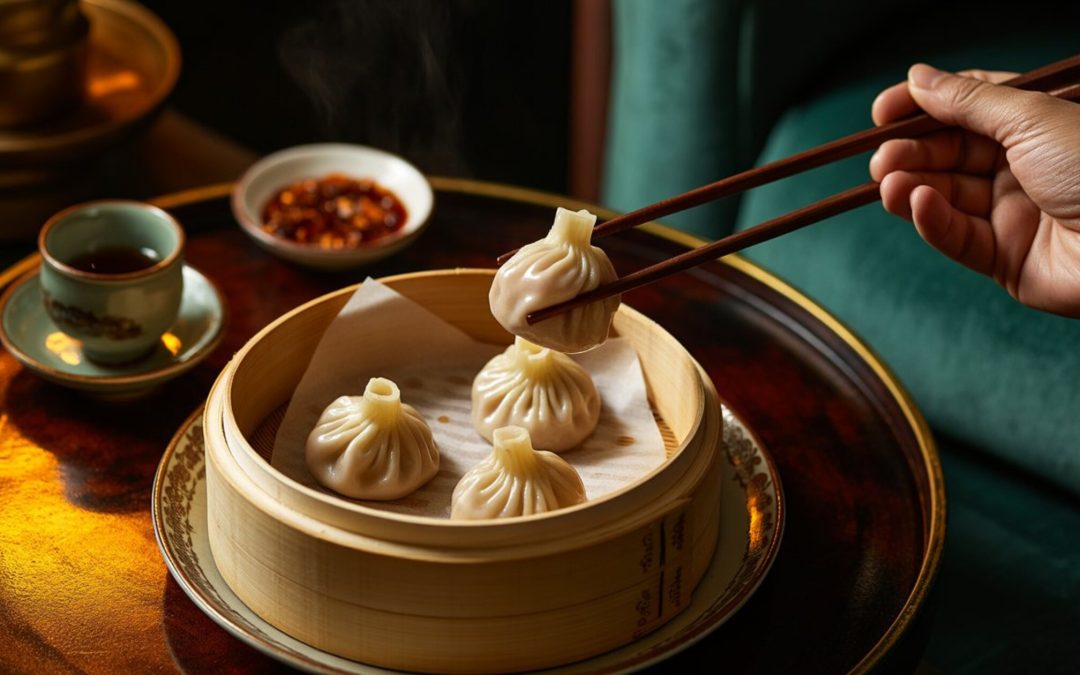
Xiao Long Bao are soup dumplings. Toki makes them Guangzhou-style with chicken filling and a light spicy broth sealed inside. The broth starts solid and melts into liquid during steaming. Your first bite releases both the meat and a rush of hot soup. Be careful with that soup. It burns.
Siu Mai are open-topped dumplings wrapped in a thin wonton skin. The filling has water chestnut or mushroom for texture, and the top is left exposed, usually with a dot of roe. Simple, reliable, and the kind of thing every dim sum table has.
Char Siu Bao are buns filled with barbecued meat. The steamed version has a fluffy white exterior that tears apart in your hands. The baked version has a golden, sweet glaze. They are effectively two different dishes sharing a name. Both are worth ordering.
Cheung Fun are rice noodle rolls. A thin rice flour batter, steamed flat, then rolled around shrimp or char siu and dressed with soy. The texture is slippery, silky, and completely unlike anything in the dumpling category. First-timers often skip it. Regulars order it every week. Do not skip it.
For the full breakdown of how steamed, fried, and baked dim sum differ and why that matters for your order, Types of Dim Sum You’ll Find at Toki walks through each category.
A suggested first order at Toki
Table of two to four people. Here is how to handle it without overordering.
First round: Crystal Shrimp Har Gao, Xiao Long Bao, one steamed vegetable dumpling. Three steamers. Classic, clean, and a solid baseline for everything that follows.
Second round: One baked Char Siu Bao for crunch. One fried dumpling. One cheung fun with shrimp. This is where you start feeling the texture range, soft to crispy to silky in three dishes.
Third round: Whatever caught your attention. A second order of the Har Gao is always a good move. Or try something new. Taro puff, turnip cake, anything you have not tried before.
To finish: An egg custard tart or a sesame ball alongside the last of your tea. Or nothing. Your call entirely.
Mistakes to avoid
Ordering everything at once. Your table gets crowded, food cools before you reach it, and the gradual buildup that makes dim sum work disappears. Order in rounds. Three or four items. Be patient.
Ignoring the tea. It is not there for atmosphere. It resets your palate between dishes. Pour for everyone else at the table before pouring your own, that is considered respectful in Cantonese tradition. When the teapot is empty, tilt the lid open. Your server will know what that means.
Biting straight into the Xiao Long Bao. Place it on your spoon first. Nibble a small hole in the side. Let the broth cool for a few seconds. Sip the soup. Then eat the dumpling. Biting in directly means a burnt tongue and broth down your shirt. Learn from other people’s mistakes on this one.
Skipping the cheung fun. It looks unfamiliar, so people pass on it. That is a mistake. The rice noodle roll is often the most technically impressive thing on the table, and the texture is something you will not get from any dumpling.
The complete dim sum guide puts all of this into broader context, where the tradition comes from, how it evolved in Jeddah, and how Toki approaches dim sum within a fine dining setting.